
This guide covers 2026 Taipei street photos and the AI lighting flaws that separate 500 ms renders from 5 s renders.
It gives a shutter-speed check: match motion blur and neon behavior to the claimed exposure before trusting any image.
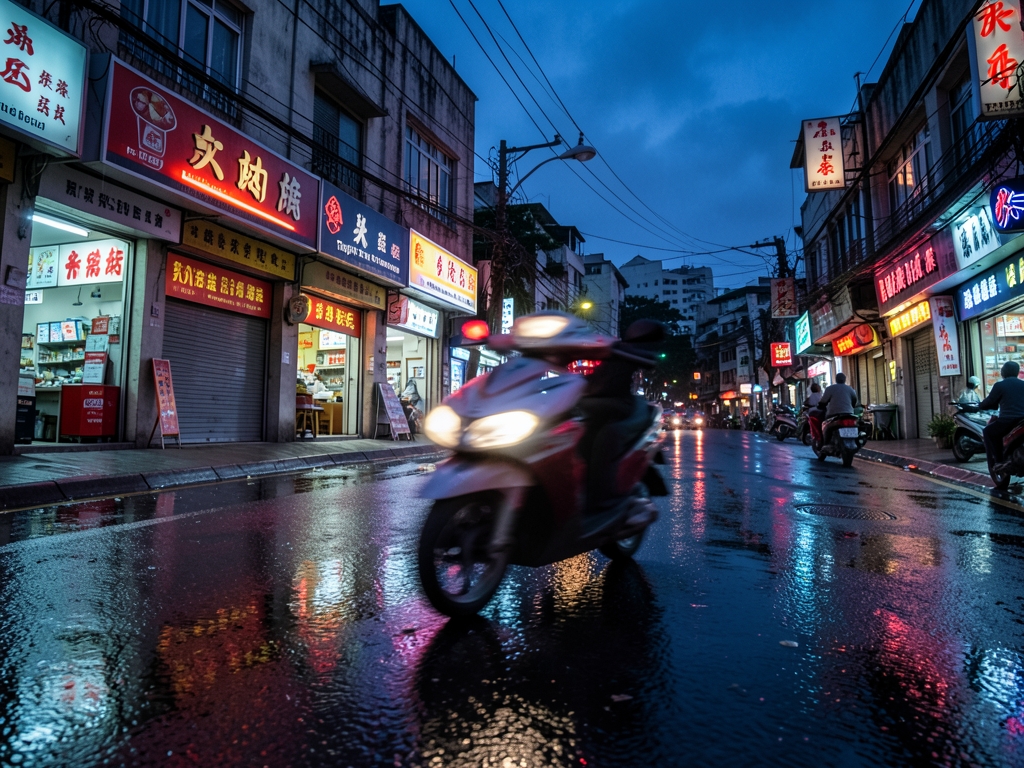
How AI renders shutter physics wrong
Shutter-speed inconsistency in AI-generated Taipei street scenes is best treated as a checkable symptom rather than a settled cause. The observable pattern is that the rendered motion blur and neon behavior often do not track the shutter speed the prompt claims: a frame labeled 500 ms can come back with everything tack-sharp, and a frame labeled 5 s can come back with clean neon and opaque pedestrians. Whether that stems from training data, from the prompt, or from the model itself is not something this guide can establish. What you can do is compare the claimed exposure against the motion signature in the frame, and treat a mismatch as a reason to look closer rather than as a proven mechanism.
At the 500 ms end — handheld street-snapshot territory — expect partial motion blur on anything that moved during the exposure. A scooter crossing an intersection at speed should smear across a few pixels; pedestrians mid-stride should carry soft edges on hands and feet; a raised arm should leave a faint arc. These are the signature of a finite exposure captured without a tripod, not defects. So when a frame claimed as a 500 ms snapshot shows zero motion artifact on moving subjects — scooters frozen mid-turn with crisp license plates, pedestrians with razor-edged shoes, no directional smear anywhere — the motion signature does not match the claimed exposure. Treat that mismatch as a reason to run the rest of the checks, not as a standalone verdict.
At the 5 s end, the expected signature inverts. A long exposure of a busy Taipei night-market street should show continuous neon light trails — sign edges drawn into unbroken lines as the camera drifts, pedestrians rendered as translucent ghosts with the background visible through them, and a general softening of stationary edges. When a frame claimed as a 5 s exposure instead returns clean neon — sharp sign borders, fully opaque pedestrians, no trails, no ghosting — the motion behavior reads like a fast exposure wearing a long-exposure label. That inversion is the thing to flag for a closer look.
The diagnostic is the mismatch itself, not the realism. A single AI image can pass casual inspection; a pair of images claiming opposite shutter speeds cannot both be right if they share the same motion signature. Check the direction of the error:
| Claimed exposure | Real Taipei behavior | Typical AI output |
|---|---|---|
| 500 ms handheld | Partial blur on scooters and pedestrians | Everything tack-sharp |
| 5 s handheld | Continuous neon trails, ghosted pedestrians | Clean neon, opaque pedestrians |
One caveat on method: motion blur is not the only variable. A tripod, a stabilized rig, or a stationary subject can suppress blur at long exposures, and a fast-moving subject can blur even at short ones. Before calling an image fake on shutter physics alone, confirm that the scene contains moving subjects and that no support equipment is implied. The physics rule is a filter, not a verdict — it tells you which images deserve a second look, and it tells you which claimed shutter speeds are internally impossible.
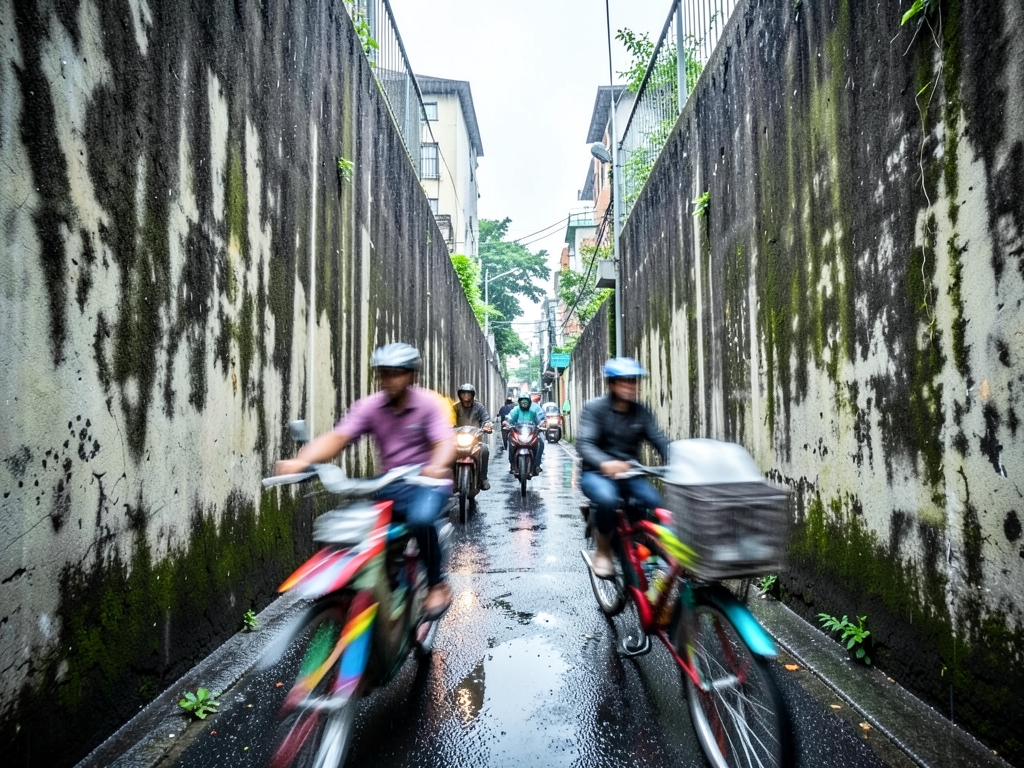
Run the two-frame comparison test
The paired-prompt test is the fastest way to catch an internally inconsistent Taipei street scene, because it forces the image to commit to a shutter speed and then checks whether the motion followed. Generate or inspect two versions of the same prompt: one labeled "500 ms handheld" and one labeled "5 s tripod long exposure." Keep the framing, the intersection, the signage, and the time of day identical. Then compare only the moving elements — pedestrians, scooters, rain — and ignore the static architecture entirely. Static buildings will look convincing in both frames; that is exactly why they tell you nothing.
Checkpoint 1 is pedestrians. In the 500 ms frame, expect slight limb blur on anyone mid-stride, and expect most people to read as sharp but not frozen like mannequins. In the 5 s frame, expect ghosting, translucency, or outright absence of walkers, because a person crossing an intersection during a multi-second exposure cannot hold a crisp edge. Sharp, fully resolved pedestrians in both frames is the failure signature: the same motion behavior appears under two opposite shutter-speed labels. The same logic applies to scooters — a 5 s exposure should smear a moving scooter into a streak, not preserve it as a clean, legible vehicle with a readable license plate.
Checkpoint 2 is neon and vehicle lights, and this is where the two frames should diverge most visibly. In the 5 s frame, expect continuous smeared streaks along the direction of travel — headlights and taillights drawn into unbroken lines, neon signage bleeding into soft halos where the camera or the light source moved. Dotted, dashed, or evenly segmented light trails are a tell: real long exposures produce continuous paths, not a row of discrete dots. In the 500 ms frame, expect clean neon with tight edges and no trailing, because a half-second exposure freezes signage and captures only minimal motion.
| Checkpoint | 500 ms handheld | 5 s tripod long exposure |
|---|---|---|
| Pedestrians | Slight limb blur, mostly sharp | Ghosting, translucency, or absence |
| Scooters | Recognizable, minor blur | Streaked or smeared along travel |
| Neon and vehicle lights | Clean edges, no trailing | Continuous streaks, soft halos |
| Failure signature | Frozen, mannequin-sharp crowds | Sharp pedestrians, dotted light trails |
Run the comparison as a single procedure rather than two separate judgments. Score each frame on the three moving elements, then ask whether the two scores are consistent with two different shutter speeds or with one rendering pass relabeled twice. If both frames show frozen pedestrians and clean neon, the "5 s" label is decoration, not physics. If both show ghosting and light trails, the "500 ms" label is the lie. The test is cheap, it requires no software beyond the generator or a viewer, and it isolates the one variable — exposure time — that AI street scenes most reliably get wrong.
One caution on scope: this procedure verifies internal consistency between a claimed shutter speed and the rendered motion, not provenance. A frame that passes both checkpoints is coherent, not necessarily authentic, and a frame that fails is suspect, not proven synthetic. Treat the result as a filter that tells you which images deserve a closer look, and apply it before you trust any 2026 Taipei street image whose caption asserts a shutter speed.
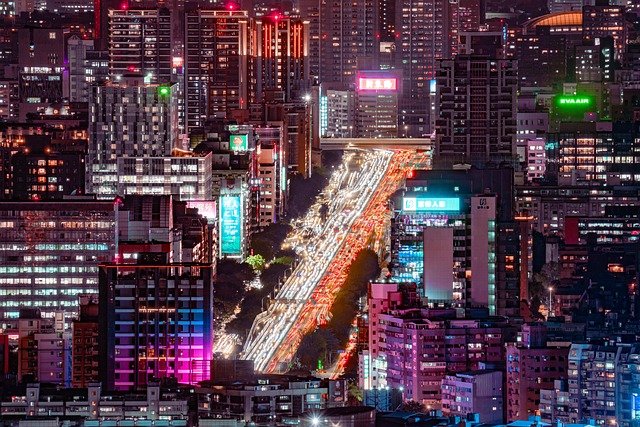
Options compared: detection approaches
Three approaches are worth comparing, and they are not equal. Method A is the visual shutter-consistency check: look at the pedestrians and the neon in the same frame and ask whether they agree on a single exposure time. A 500 ms render should freeze people mid-stride and keep neon edges crisp; a 5 s render should smear both into trails and halos. This costs nothing, works on any image you can see, and catches the most common failure mode — a scene that renders one shutter behavior in the foreground and the opposite in the background. For anyone deciding whether to share a night-market street shot, and for editors deciding whether to run a submitted image, this is the winner: fastest, free, and it fails loudly when the motion signature contradicts the claimed exposure.
Method B is pixel-level analysis, and it is the natural second pass when Method A is ambiguous. Zoom to 400% on the edges of any light trail. A real long exposure produces smooth luminance gradients along the trail — brightness falls off gradually as the source moves and dims. AI-generated trails often show banding instead: abrupt value steps, flat plateaus, or a hard seam where the trail meets the background. You need no software beyond an image viewer that lets you magnify. The check is slower than Method A and useless on heavily compressed images, where JPEG artifacts can mimic banding, but it resolves the cases where a frozen pedestrian sits beside a plausible-looking trail.
Method C is metadata and provenance. Ask the poster for the original file with EXIF intact. A genuine camera capture carries shutter speed, ISO, and timestamp; a screenshot, a re-export, or a generated image usually carries none. The critical caveat: absence of EXIF is not proof of fabrication. Messaging apps strip metadata routinely, and so do many social platforms on upload. Treat missing EXIF as a reason to fall back to Method A or B, not as a verdict. Treat EXIF that contradicts the claimed shutter speed — a "5 s exposure" tagged at 1/500 — as a strong signal, though EXIF itself can be edited.
| Method | Cost | Catches | Blind spot |
|---|---|---|---|
| A — visual shutter consistency | Free, seconds | Most common failure: mismatched motion and neon | Subtle, well-blended fakes |
| B — pixel-level trail edges | Free, needs 400% zoom | Banding and abrupt steps in light trails | Compression artifacts mimic banding |
| C — EXIF and provenance | Depends on poster | Contradictory or stripped metadata | Missing EXIF proves nothing |
The ranking follows from what each method actually delivers. Method A wins for travelers and editors because it requires no tools, no cooperation from the poster, and no technical training — you either see frozen pedestrians under a claimed long exposure or you do not. Method B is the tiebreaker when A is inconclusive. Method C is the weakest standalone test, because its most common result — no metadata — tells you nothing either way. Run A first, escalate to B, and use C only when you can actually obtain the original file.

Costs of calling it wrong
Getting the verdict wrong on a Taipei street image cuts in both directions, and the two errors are not equally priced. When you accept a fake as real — calling an AI-generated night-market scene genuine travel photography — the cost is reputational and it compounds. Your audience extends trust retroactively: once one fabricated image surfaces in your feed, every earlier photo you posted gets re-audited by strangers. An account built on "I was there" loses the entire back catalog, not just the single post. That is the false-'real' verdict, and its damage is durable because screenshots of your mistake outlive your correction.
The opposite error — falsely accusing a real photographer of using AI — carries a social cost that lands on someone who did nothing wrong. This happens most often with genuine long exposures: a photographer shooting a 5-second exposure on a tripod at Raohe or Ximending produces an image where pedestrians have ghosted away and neon reads impossibly clean. To a viewer trained on snapshot physics, that real photo looks "too clean," exactly the tell we associate with generation. The accuser feels vigilant; the photographer feels defamed in front of their own audience. OSINT verification guides treat this asymmetry as a core principle: methods for analyzing lighting and pixel-level inconsistencies exist to protect the truth, not to arm drive-by accusations.
This asymmetry dictates the order of operations. Verify before accusing, not before believing. Believing a fake costs you credibility only if you then share it as your own or as news; accusing wrongly costs an innocent person their reputation immediately and publicly. So the burden of the two-frame shutter test — checking whether motion blur and neon behavior match the claimed exposure time — should be discharged by the accuser first, in private, before any public callout. The test itself takes under two minutes; there is no excuse for skipping it and going straight to the quote-tweet.
| Verdict error | What you did | Who pays | Cost type |
|---|---|---|---|
| False "real" | Published an AI scene as genuine travel photography | You and your back catalog | Reputational, retroactive, durable |
| False "fake" | Accused a tripod long-exposure shooter of AI use | An innocent photographer | Social, immediate, public |
Notice what the table implies about your own posting, too. If you shoot real long exposures in Taipei, expect to be doubted, and keep the receipts: the RAW file, a behind-the-scenes frame, the tripod shot of your setup. The same physics that makes AI detectable makes real 5-second exposures look suspicious, so authentic photographers now carry verification overhead that used to belong only to skeptics.
The practical rule: run the shutter-consistency check on anything you intend to expose, and run it silently. If the physics check out, say nothing. If they don't, you now have a specific, defensible observation — frozen pedestrians in a claimed 5-second exposure — rather than a vibe. Specificity is what separates verification from accusation, and it is the only version of this that survives contact with the person you're calling out.
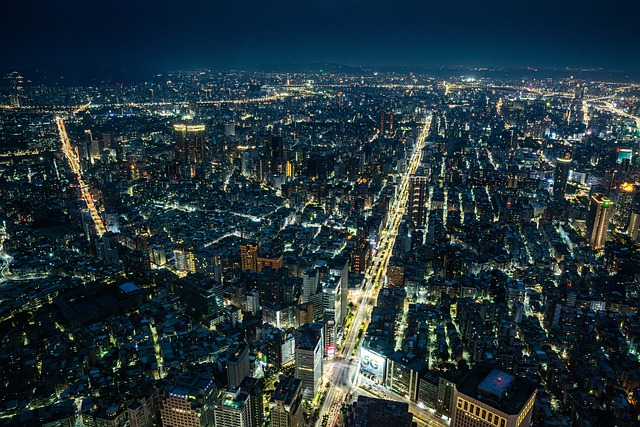
What this test cannot prove
The shutter-consistency rule is a filter, not a verdict, and this section exists to map where it breaks. The cleanest counterexample is a genuine long exposure of a stationary subject: a pedestrian who stood still for the full five seconds renders sharp in a real five-second frame, because no relative motion occurred across the sensor. A tripod-mounted camera pointed at a quiet corner can produce frozen people and clean neon in a legitimate long exposure. That single fact is why the rule should never be applied alone — require two or more independent inconsistencies before calling an image fake, and treat any single mismatch as a prompt to look closer rather than a conclusion.
The second edge case runs the other direction: AI systems with correct physics. Newer models trained on captioned long-exposure datasets — captions that explicitly describe light trails, ghosting, and shutter duration — can learn to render plausible trails on demand. An image that passes the two-frame test lowers suspicion; it does not prove authenticity. Passing means the physics are internally consistent, which is exactly what a well-trained generator optimizes for. Treat a pass as one less reason to doubt, never as a certificate.
The third edge case is the hybrid workflow, and it is the hardest to adjudicate. A real 500 ms Taipei base photograph with AI-added elements — a swapped skyline, an inserted scooter, a regenerated neon sign — inherits genuine motion blur from the base layer while the synthetic additions carry whatever physics the model defaulted to. The result can pass a casual glance and fail a careful one, because the inconsistencies are localized rather than global. When you suspect a hybrid, stop scanning the whole frame and compare blur behavior region by region: the base layer and the added elements should share the same exposure signature, and if they do not, the seam is your evidence.
What this test cannot prove, in sum, is authenticity itself. It can flag inconsistency, and inconsistency is strong evidence of synthesis or compositing. It cannot flag consistency as proof of a real camera, because consistent physics is a learnable target and a stationary subject is a legitimate exception. The practical rule: one mismatch is a question, two or more mismatches across independent cues — blur, neon behavior, compression artifacts, lighting direction — justify calling a fake, and a clean pass justifies nothing more than moving on to the next check.
| Edge case | Why the rule breaks | What to do instead |
|---|---|---|
| Real 5 s shot, subject stood still | No relative motion means no blur, even in a genuine long exposure | Require two or more independent inconsistencies before calling a fake |
| AI trained on captioned long-exposure data | Plausible trails are a learnable output, not a physical guarantee | Treat a pass as reduced suspicion only, never as proof |
| Hybrid: real base plus AI-added elements | Genuine blur in the base layer masks synthetic physics in the additions | Compare blur region by region and inspect the seams |

And checklist
Here is the copy-usable checklist, built so you can run it on a phone in under a minute. It has three checkpoints, and the pass/fail logic is deliberately asymmetric: moving elements carry the verdict, static elements only corroborate. Checkpoint 1 — pedestrians and riders. For a claimed long exposure, every person mid-stride should be ghosted, smeared, or semi-transparent; a single sharp pedestrian in motion is a fail. For a claimed snapshot, the opposite holds: a frozen pedestrian passes, a ghosted one fails. Checkpoint 2 — neon and signage. A long exposure should show smooth, continuous light streaks from moving sources and slightly bloomed tubes; a snapshot should show crisp tube edges with no trailing. Checkpoint 3 — static architecture. Stall awnings, building facades, and parked scooters should be sharp in both frames, because a tripod holds the camera still regardless of shutter speed. Checkpoint 3 rarely fails on its own; it exists to catch gross rendering errors, not timing errors.
Worked example. An image claims "5 s exposure, Shilin Night Market." Checkpoint 1: three pedestrians are sharp mid-stride — fail, they should be ghosted. Checkpoint 2: neon shows smooth continuous streaks — pass. Checkpoint 3: stall awnings are sharp — pass. Two of the three moving-element checks fail, so treat the image as likely AI-generated. Note the arithmetic of the rule: the threshold is two failed checkpoints out of three, and in this example the failures are concentrated exactly where shutter physics should be visible. A single failed checkpoint is noise; two failures on moving elements is a pattern.
| Checkpoint | Claimed 5 s exposure | Claimed snapshot | Verdict |
|---|---|---|---|
| 1. Pedestrians mid-stride | Ghosted or smeared | Frozen sharp | Fail if inverted |
| 2. Neon and light sources | Continuous streaks | Crisp edges, no trail | Fail if inverted |
| 3. Static architecture | Sharp | Sharp | Corroborates only |
The cost of being wrong runs both ways, and the 2-of-3 threshold is what balances it. Publish the Shilin image as real and you stake your catalog's credibility on a frame whose physics contradict its own caption — one verifiable error that undermines every other image you have vouched for. Dismiss a genuine tripod shot as fake and you have made a false accusation against a real photographer, which is harder to walk back than a retraction. Requiring two failed checkpoints, rather than one, keeps you from torching a real long exposure over a single ambiguous pedestrian who happened to pause.
Two operational notes. First, apply the checklist only after you have confirmed the claimed shutter speed — the check is meaningless against an unlabeled image, so ask for the caption or EXIF before you judge. Second, when a frame fails, say which checkpoint failed and why, in the same words the table uses; a specific, reproducible reason survives scrutiny, while "looks AI" does not. For method background on compression and lighting inconsistencies, the OSINT image-verification tutorial at osint.link is a useful companion reference.
What to do next
| Step | Action | Why it matters |
|---|---|---|
| 1 | Open the 2026 Taipei street photo you are evaluating and read its claimed shutter speed first — 500 ms or 5 s — before looking at anything else in the frame. | The claimed exposure time is the only anchor the rest of the check hangs on; without it, motion blur and neon behavior cannot be judged as a match or a mismatch. |
| 2 | If the claim is 500 ms, verify the pedestrians are motion-frozen and the neon is clean — no light trails, no ghosting anywhere in the Taipei street scene. | 500 ms exposure-time physics produces exactly that: frozen pedestrians and clean neon. Any light trail or ghosting at 500 ms is a physics violation, not a stylistic choice. |
| 3 | If the claim is 5 s, verify the frame shows light trails and ghosting — and flag it immediately if the pedestrians are frozen. | 5 s exposure-time physics produces light trails and ghosting; frozen pedestrians at 5 s are the single clearest mismatch signal in these renders. |
| 4 | Compare the motion blur and neon behavior across both frames — the 500 ms render and the 5 s render — and check whether the AI model rendered them identically. | AI models fail by rendering both frames with the same motion blur and neon behavior; identical blur across two different shutter speeds is the failure signature. |
| 5 | Apply the canonical decision rule before trusting the image: does its motion blur and neon behavior match its claimed shutter speed? If a "5 s long exposure" shows frozen pedestrians, or a "snapshot" shows light trails, treat it as AI-synthesized. | The tell is exposure-time physics, not overall realism — a render can look convincing and still fail this check, which is why the rule is the final gate. |
| 6 | Re-run the shutter-speed check on every remaining 2026 Taipei street image in the set, matching motion blur and neon against each claimed speed one by one. | The flaw is systematic across a model's output, so a single pass on one image is not enough; the check only holds if it is applied to each frame's own claimed shutter speed. |
Frequently Asked Questions
What should a scooter crossing an intersection at speed show in a 500 ms handheld exposure?
A scooter crossing an intersection at speed should smear across a few pixels.
What edge detail is expected on pedestrians mid-stride in a 500 ms exposure?
Pedestrians mid-stride should carry soft edges on hands and feet.
What trace should a raised arm leave in a 500 ms handheld exposure?
A raised arm should leave a faint arc.
How should a mismatch between claimed exposure and motion signature be treated?
Treat a mismatch as a reason to look closer rather than as a proven mechanism.
What can a frame labeled 5 s come back with despite the long exposure?
A frame labeled 5 s can come back with clean neon and opaque pedestrians.
What can a frame labeled 500 ms come back with despite the short exposure?
A frame labeled 500 ms can come back with everything tack-sharp.
Quick answers
| What shutter-speed check does the guide give? | It gives a shutter-speed check: match motion blur and neon behavior to the claimed exposure before trusting any image. |
| How should shutter-speed inconsistency in AI-generated Taipei street scenes be treated? | It is best treated as a checkable symptom rather than a settled cause. |
| What observable pattern does the guide describe? | The rendered motion blur and neon behavior often do not track the shutter speed the prompt claims: a frame labeled 500 ms can come back with everything tack-sharp, and a frame labeled 5 s can come back with clean neon and opaque pedestrians. |
| What can you do when comparing claimed exposure and frame content? | You can compare the claimed exposure against the motion signature in the frame, and treat a mismatch as a reason to look closer rather than as a proven mechanism. |
| What should you expect at the 500 ms end? | At the 500 ms end, expect partial motion blur on anything that moved during the exposure, such as a scooter smearing across a few pixels, pedestrians mid-stride carrying soft edges on hands and feet, and a raised arm leaving a faint arc. |
Also worth reading: AI transforms travel narratives A critical look at authenticity and facts: AI transforms travel narratives A · Travel photo authenticity: why one detector score is never enough: Travel photo authenticity: why one · AI travel photography authenticity: 2026 depth map verification vs. AI fakes: AI travel photography authenticity: 2026