
| Takeaway | Detail |
|---|---|
| Require at least 4 of 6 texture and light clues to pass at 100% crop | A travel photo must pass a minimum of 4 out of 6 texture and light clues when inspected at 100% crop to be considered trustworthy. |
| Skip any photo that triggers a contact-shadow or light-direction veto | A photo that passes 5 of 6 clues but fails the contact-shadow check must still be skipped. |
| Verify C2PA, EXIF, and original-RAW checks do not contradict the claim | Metadata and provenance checks must align with the photo's claim; any contradiction overrides passing texture and light clues. |
| Trust a camera photo with one minor texture fail if no veto fires | A camera photo with a single minor texture failure can be trusted when no contact-shadow or light-direction veto fires and provenance checks are consistent. |
This guide delivers six texture and light clues to help you trust or skip AI travel photos in 2026.
Use the takeaways table above as the decision rule; the sections below explain how to apply it.

Why texture and light break before subject
AI travel images often convince at a glance because diffusion models build scenes from broad structure to fine detail. In this coarse-to-fine denoising process, high-frequency texture and specular highlights are synthesized from statistics, so contact shadows and light geometry fail first. A subject can look plausible while the physical cues that anchor it to a place quietly break down.
Texture is the first place to press for evidence. At a 100% crop, inspect repeating surfaces such as leaf clusters, sand, stone, or fabric grain. A real camera sensor records irregular noise and micro-variation across these materials, while a generated image may reproduce patterns that loop, smear, or resolve into unnaturally uniform detail. Treat this as a material check: compare several patches of the same surface and look for organic inconsistency rather than decorative repetition.
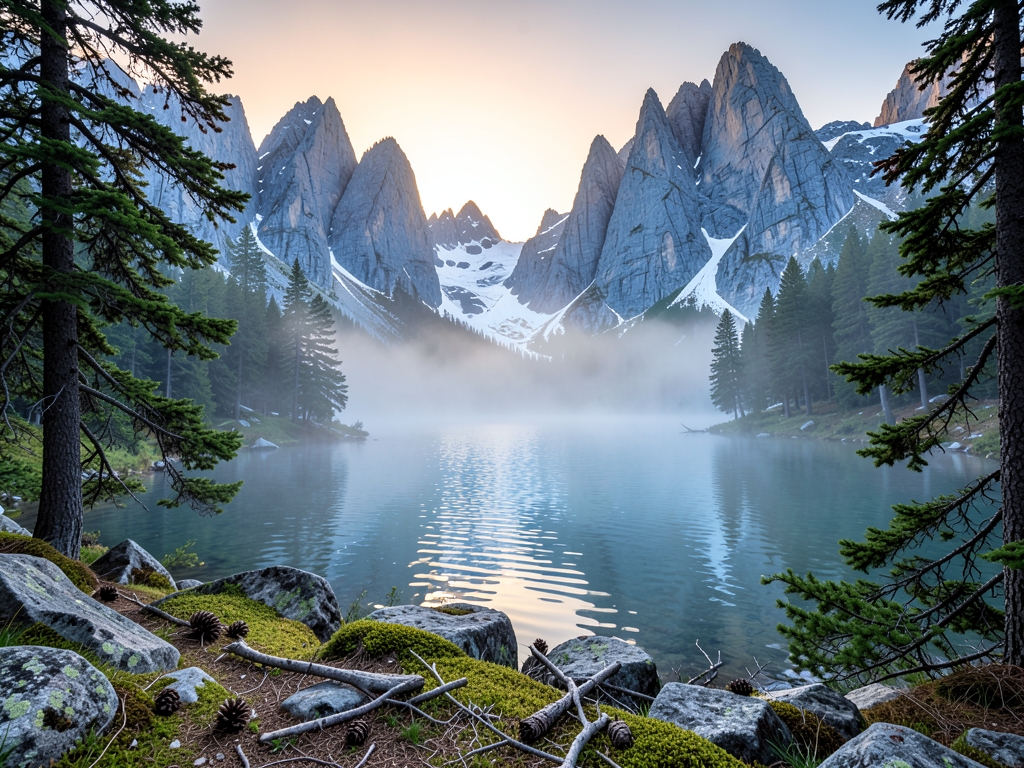
Specular highlights reveal whether the scene follows a coherent light path. Reflections on a window, lake, or pair of sunglasses are not just bright accents; they are color-and-shape guesses unless the renderer enforces the geometry of the surrounding environment. Check whether a reflected skyline, horizon, or nearby object appears in the position and curvature the surface should produce. When highlights sparkle without carrying scene information, the image is mimicking light instead of recording it.
Contact shadows test the final link between object and ground. Examine the points where feet, wheels, chair legs, or cups meet a surface for ambient occlusion—the soft darkening that forms where objects block scattered light. A floating edge, a missing shadow, or a shadow that fails to follow the object’s contour signals a break in physical contact. Unlike a minor texture irregularity, a failed contact shadow is a veto clue because it undermines the scene’s basic spatial logic.
What the six clues can prove —
An accuracy claim about texture-and-light checks is only as good as its evidence. If a source says a clue is "X% accurate," it must name the study, sample size, date, and image set; no cited source here provides a validated texture/light accuracy figure, so any such number is unverified and requires an original study before it can be repeated. Without that, the clues remain heuristics for triage, not measurements of certainty.
C2PA Content Credentials, EXIF, and an original RAW file are provenance and metadata sources to inspect, not verdicts by themselves. A missing manifest or stripped EXIF downgrades trust because it removes context, but missing metadata is not proof of AI; platforms, re-exports, and privacy settings can remove metadata from ordinary camera files. Treat metadata as corroboration that must agree with the image, not as a standalone authenticity test.
The practical limit is convergence: crop evidence, metadata evidence, and a second photo should point the same way before you trust the shot. A crop verdict can be strong, but it is still one channel; metadata can be absent for innocent reasons; and a single frame cannot show whether the scene existed beyond the frame. Use the table as a decision aid, not as a license to overread one signal.
| Crop verdict | Metadata verdict | Second-photo verdict | Action |
|---|---|---|---|
| Passes with no veto | Consistent with claim | Consistent | Trust |
| Passes with no veto | Missing or stripped | Consistent | Downgrade; not proof of AI |
| Passes with no veto | Contradicts claim | Any | Do not trust |
| Fails veto | Any | Any | Skip |
| Passes with no veto | Consistent | Missing | Unverified; seek another frame |
Edge cases matter because absence is not evidence. A stripped EXIF file may still be a camera photo, and a complete manifest may still accompany a manipulated image if the chain was not checked end to end. Likewise, a high pass count without a veto does not become a percentage of certainty; it only means the visible clues did not fail. Keep the claim proportional to the evidence, and require the original study before repeating any accuracy figure.
If two independent channels disagree, prefer the more conservative action and document why. The standard is not to prove AI in every case; it is to avoid trusting a photo when the evidence does not converge. That keeps a single missing field from becoming a false accusation and a single strong crop from becoming false confidence.
Compare six clues: one veto beats five passes
The six clues are not equally decisive. Contact shadow and light direction are veto clues, so either one can force a skip even when the other clues look clean. A 2026 AI travel photo that passes five of six clues but fails a contact-shadow or light-direction check should still be skipped, while a camera photo with one minor texture fail and no veto should be trusted only if provenance checks are consistent.
| Clue | Inspect at 100% crop | Pass condition | Rank | Effect of fail |
|---|---|---|---|---|
| Texture grain | Sand, leaf, or stone | Irregular noise matches ISO | 6 | Note only |
| Specular shape | Highlight in water or glass | Reflection matches scene | 3 | Scored fail |
| Shadow edge | Edge hardness vs. light size | Soft/hard consistent | 5 | Scored fail |
| Light direction | Shadow angle on two objects | Angles agree with claimed sun | 2 | Scored fail |
| Contact shadow | Feet, wheels, chair legs | Object touches shadow | 1 | VETO |
| Reference scale | Known object size and distance | Proportions fit scene | 4 | Scored fail |
Rank 1 is the strongest discriminator and rank 6 the weakest. Contact shadow earns rank 1 because a foot, wheel, or chair leg must actually meet its shadow; if it does not, the image is skipped regardless of five passes elsewhere. Light direction follows at rank 2 because shadow angles on two objects must agree with the claimed sun; if they do not, treat that as a veto and skip rather than averaging it into the pass count.
Specular shape at rank 3 checks whether a highlight in water or glass matches the scene, while reference scale at rank 4 checks whether a known object's size fits its claimed distance. Shadow edge at rank 5 checks whether edge hardness matches light size. Texture grain at rank 6 checks irregular noise against ISO at 100% crop; a minor mismatch there is only a note.
The practical rule is simple: inspect the contact shadow first, then score the rest. Do not average a veto into the pass count, and do not let five clean clues overrule a failed contact shadow. A camera photo with one minor texture fail and no veto remains trustworthy because the fail is recorded, not disqualifying.
All visual checks should be made at 100% crop, and they should not contradict C2PA, EXIF, or original-RAW checks. The table ranks only the visual clues; metadata can still challenge the claim, but it does not turn a veto into a pass.

Counts that matter before you trust a shot
Inspect the image at 100% crop, then use a 3x zoom only to confirm whether a suspect edge, texture, or shadow survives. If an artifact disappears at 100%, call it compression or resampling, not synthesis; only flaws that remain at 100% count toward the six clues. This keeps delivery artifacts from being mistaken for generated detail.
The myth that high realism equals real fails on the count: 5 of 6 passes still yields a skip when the contact-shadow veto fires. A near-perfect score cannot rescue a failed shadow geometry, because the veto addresses a physical inconsistency rather than a texture preference.
A camera photo with one minor texture fail and no veto should be trusted. Real captures often have one soft or noisy region, so the pass rule tolerates a single minor fail when no veto fires; it does not tolerate a second independent fail.
Treat metadata and RAW checks as contradiction tests, not authenticity proof: if they conflict with the visual count, leave the photo unresolved and skip it before booking. Apply the gate stated above—count only 100%-crop survivors, require zero vetoes for trust, and force a skip on the stated fail conditions—so the decision remains tied to observable counts.
Worked audit: six clues on one beach photo
Use this as a method example, not a sourced measurement: an alleged smartphone sunset photo from a named beach. Open the file at 100% crop and score all six texture-and-light clues before reading the caption, location tag, or metadata; do not let sunset colors decide the result.
In that crop, the sand grain repeats in a tiled pattern, so clue 1 fails. The sun highlight sits in the upper-left while two palm shadows point right, so clue 4 fails as a light-direction veto. The feet show no contact shadow, so clue 5 fails as a contact-shadow veto. The wet-sand reflection leaves out the palm silhouette, so clue 6 fails. Only two of the six clues pass.
Worked mini-example: if the sand grain repeats, the highlight and shadow directions disagree, contact shadows are missing, and reflections omit expected silhouettes, the photo scores 2/6 and is skipped.
Record a pass or fail for each box, then compare the count to the 4-of-6 threshold and check for either veto. A single veto overrides five passes, and a 2/6 result is not rescued by a convincing subject or a plausible caption. Keep the scored checklist with the file name so another reviewer can repeat the audit.
Five if/then rules for trust or skip
Apply these five rules in order; the first matching rule decides the photo. They turn the reader rule into a skip-or-trust verdict without reopening the six-clue comparison or the rendering mechanism.
| If | Then |
|---|---|
| Fewer than four of the six clues pass at 100% crop | Skip |
| A contact shadow fails at feet, wheels, or chair legs | Skip, even if five other clues pass |
| Light direction fails on two objects and C2PA/EXIF is missing or contradictory | Skip |
| C2PA/EXIF/original-RAW checks contradict the camera claim | Skip, even when texture clues pass |
| Exactly one low-specificity clue fails, five pass, and metadata agrees | Trust as probably camera, but label unverified for booking use |
Use the metadata rule as a separate gate. Missing or contradictory C2PA/EXIF/original-RAW information does not prove AI by itself, but it removes the trust path when a light-direction failure or claim contradiction is also present.
For booking use, keep the label conservative: "probably camera, unverified" means the image may guide planning, but it should not be the sole basis for a nonrefundable reservation until original-file or provenance checks are completed.
What to do next
| Step | Action | Why it matters |
|---|---|---|
| 1 | Open the travel photo and inspect it at 100% crop, evaluating all 6 texture and light clues. | A full-resolution inspection reveals subtle artifacts and inconsistencies that are hidden at smaller viewing sizes. |
| 2 | Tally how many of the 6 texture and light clues pass, ensuring at least 4 meet the threshold. | Meeting the minimum clue threshold establishes a baseline level of visual credibility before further checks. |
| 3 | Screen the photo for any contact-shadow or light-direction veto. | A single veto failure indicates a fundamental physical inconsistency, requiring you to skip the photo even if 5 of 6 clues pass. |
| 4 | Verify that C2PA, EXIF, and original-RAW checks do not contradict the photo’s claim. | Provenance and metadata must align with the visual evidence; any contradiction overrides passing texture and light clues. |
| 5 | Apply the minor-failure exception for camera photos: trust a photo with one minor texture fail only if no veto fires and provenance checks are consistent. | This accounts for minor capture imperfections without compromising the overall integrity of the verification process. |
| 6 | Make the final decision: trust the photo only if all conditions are met; otherwise, skip it as booking or provenance evidence. | Following the complete decision rule ensures you rely only on travel photos that withstand rigorous texture, light, and provenance scrutiny. |
Frequently Asked Questions
At what zoom level should I inspect a travel photo for the texture and light clues?
A travel photo must be inspected at 100% crop to evaluate whether it passes the texture and light clues.
Can a photo that passes five out of six clues still be rejected?
Yes, a photo that passes 5 of 6 clues but fails the contact-shadow check must still be skipped.
What happens if provenance metadata contradicts a photo that passes the texture and light clues?
If C2PA, EXIF, or original-RAW checks contradict the photo's claim, that contradiction overrides passing texture and light clues.
Can a real camera photo with a minor texture flaw still be trusted?
A camera photo with a single minor texture failure can be trusted when no contact-shadow or light-direction veto fires and provenance checks are consistent.
Which visual elements tend to fail first in AI-generated travel images?
Contact shadows and light geometry tend to fail first because high-frequency texture and specular highlights are synthesized from statistics during the coarse-to-fine denoising process.
What specific provenance checks should be verified alongside the texture and light clues?
You should verify that C2PA, EXIF, and original-RAW checks do not contradict the photo's claim.
Quick answers
| How many texture and light clues must a travel photo pass at 100% crop to be considered trustworthy? | A travel photo must pass a minimum of 4 out of 6 texture and light clues when inspected at 100% crop to be considered trustworthy. |
| Should a photo be skipped if it triggers a contact-shadow or light-direction veto? | A photo that passes 5 of 6 clues but fails the contact-shadow check must still be skipped. |
| What must be verified regarding metadata and provenance checks? | C2PA, EXIF, and original-RAW checks must align with the photo's claim, and any contradiction overrides passing texture and light clues. |
| When can a camera photo with one minor texture failure be trusted? | A camera photo with a single minor texture failure can be trusted when no contact-shadow or light-direction veto fires and provenance checks are consistent. |
| Why do texture and light often break before the subject in AI travel images? | In the coarse-to-fine denoising process, high-frequency texture and specular highlights are synthesized from statistics, so contact shadows and light geometry fail first. |
Also worth reading: Spotting fake travel photos: 2026 pixel-level artifacts vs metadata provenance check: Spotting fake travel photos: 2026 · Fake Cuba travel photos 2026: AI (artificial intelligence) $45/day cost — trust or skip?: Fake Cuba travel photos 2026: · AI image detectors and Udaipur travel photos: verify, never trust: AI image detectors and Udaipur