
| Takeaway | Detail |
|---|---|
| Travelers heading airport-to-city, Waverley, or St Andrew Square should take the tram. | For 1–3 people, the tram is the recommended option on the airport–Waverley–St Andrew Square axis. |
| Count the group before booking: parties of 1–3 should take the tram. | The tram uses a fixed per-head fare, so no coach-cost splitting is required for groups of three or fewer. |
| Parties of 4 or more should price a coach charter before choosing. | Take the coach only if its per-head cost is lower than the tram fare; otherwise, everyone should take the tram. |
| A coach is most competitive for groups of 4+ or trips originating outside Edinburgh. | The stated rule favors a charter for 4+ travelers, while an intercity coach is preferable only for people coming from outside Edinburgh. |
This guide compares tram and coach travel for Edinburgh Festival 2026, with a simple group-size rule for airport-to-city and central Edinburgh routes. It identifies when a coach charter becomes worthwhile and when the fixed per-head tram fare is the better choice.
How the two routes actually work
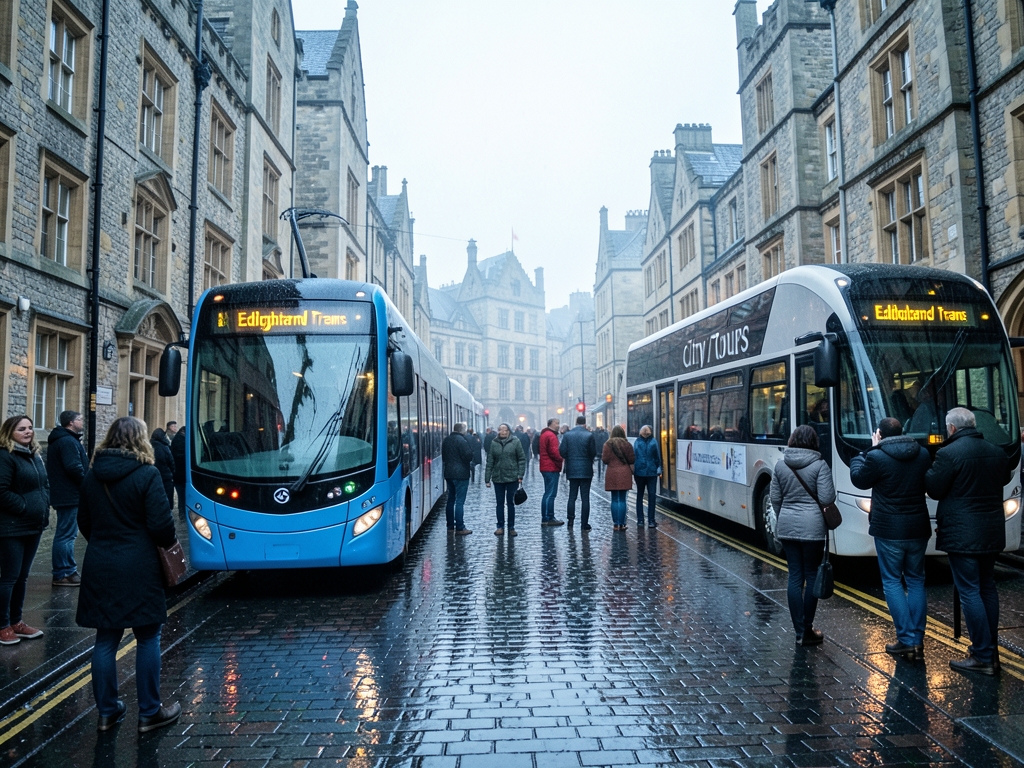
Edinburgh Airport has a direct tram link into the city, providing a straightforward connection for delegates attending the festival. A June 2026 conference-planning guide from miceconcierge.com identifies direct tram links from Edinburgh Airport as one of the city’s transport strengths. The route takes travellers toward Waverley and St Andrew Square, placing them close to the central area where many Fringe and festival venues are concentrated. That makes the tram a practical option not only for reaching the city centre, but also for moving along the airport–Waverley–St Andrew Square axis without having to work out a separate coach transfer for every leg.
For a solo traveller or a pair, the key advantage is operational simplicity: board the tram at the airport and continue into central Edinburgh without needing to divide a vehicle price or coordinate a shared pickup. Travellers using the tram should still check the operator’s published route and timetable for their travel date, particularly if their accommodation is outside the central corridor. The tram serves the useful festival axis, but the best stop depends on where the traveller is ultimately going. Anyone staying at the far end of the route should confirm whether walking from Waverley or St Andrew Square is practical or whether another local connection is more convenient.
A scheduled intercity coach is a different proposition. It may bring a traveller into Edinburgh Bus Station rather than directly to the tram corridor, so the last part of the journey may require an onward connection on foot or by local transport. It is best understood as a useful arrival option when its scheduled timetable and destination align with the group’s plans. Before booking, check the departure airport, arrival point, travel date, and transfer required from Edinburgh Bus Station to the final hotel or festival venue. A coach that looks attractive as a direct journey can lose its advantage if it adds an inconvenient transfer or arrival time.
A private charter coach works by reserving a vehicle for a defined journey or period of use. Here, the comparison is based on the total quoted vehicle price rather than a separate fare for each passenger. Ask the operator for an all-in quote that states the vehicle capacity, luggage allowance, pickup point, drop-off point, waiting time, and whether the quoted period covers the return journey. A quotation that does not identify those inclusions is not yet comparable with the tram option.
The two coach mechanisms should therefore be checked separately. A scheduled intercity service is assessed by timetable, arrival station, and onward transfer; a charter is assessed by the scope and total price of the reserved vehicle. For either, obtain the current quote for the intended date and route before booking, rather than assuming that “coach” denotes the same journey or cost structure.

The evidence: what the sources converge
The clearest signal for treating transport reliability as a business concern comes from the Edinburgh conference-planning guide from miceconcierge.com, which frames delegate travel and timing around one of the world's largest arts festivals. The guide does not publish a per-day delegate spending figure, so do not quote one; if you want to weigh the cost of a missed connection, ask your event organiser what a delayed arrival would actually cost your schedule, and value punctuality alongside the ticket price on that basis.
That finding does not mean every attendee will spend that amount or that transport accounts for any particular share of it. It does mean that delays, missed connections, and uncertain transfers can have consequences for delegates whose event commitments are tied to schedules and professional obligations. The practical check is therefore to value punctuality and dependable onward movement alongside the ticket price.A second signal comes from BBC News, which reports that Edinburgh Airport increased its kerbside drop-off charge from £6 to £8.50. This is a concrete price signal for travelers comparing private-car access with public transport, but it is not, by itself, a complete comparison of airport travel costs. Kerbside charges can be only part of a private-car journey, while public-transport prices may depend on the ticket or travel pattern purchased. The correct check is to compare the complete cost a traveler would actually incur under each option, including every airport-access charge they must pay.
Together, the sources point in the same direction without making the same claim. The chamber’s figure describes the economic weight of an international business-event visit, whereas the BBC fee change describes one identifiable airport-access price movement. The first supports giving transport reliability real consideration; the second makes clear that access around the airport is not immune from festival-season price pressure. Neither source proves that public transport will always be cheaper for a particular group. Each supports a narrower conclusion: transport should be judged by total, verifiable cost and operational dependability, not by a single headline number.
Use the evidence in a fixed order. First, confirm the current public-transport fare directly with the operator and confirm the current airport drop-off charge directly with the airport or the BBC report. Second, add the charges that each option will genuinely incur, without mixing a drop-off fee, a full journey cost, and a delegate expenditure estimate into one calculation. Third, compare options for the traveler’s actual circumstances, including group size, luggage, onward destination, and the value of avoiding a failed connection. The sourced evidence does not replace those checks; it establishes why they matter. When a traveler’s event schedule or international spending profile makes a disruption expensive, the lower-fare option is not automatically the lower-risk option.
Tram vs coach: the comparison table
The comparison starts with a simple rule: count the travellers before comparing options. A tram is the default for one to three people because its fare is fixed per head, so there is no need to divide a vehicle price or worry about how the group size changes the calculation. It also avoids the road congestion that can slow road-based travel around the Old Town in August.
The central calculation should be kept deliberately simple: compare the coach’s total quote divided by the final number of travelling passengers with the relevant tram fare per passenger. Use the same journey basis on both sides; do not compare a return coach quotation with a one-way tram ticket, or a quoted vehicle price with a per-person fare. If the coach quotation includes waiting time or an unpriced extra, obtain a revised total before making the decision.
For anyone arriving from outside Edinburgh, the result may differ because the airport transfer or onward leg is part of the full trip rather than the Edinburgh journey alone. Add each required stage to the coach quote before dividing the combined total by the number of people, then compare that result with the total tram-based cost for the same travellers. This check prevents a cheaper central coach hire from appearing attractive while the group’s complete door-to-door or airport-to-destination arrangement is actually more expensive.
5 friends, airport to Old Town
For five friends arriving at Edinburgh Airport in August 2026 and staying in the Old Town, the first decision is not which vehicle sounds better—it is how many heads the price is divided across. Edinburgh Airport has a direct tram link into the festival core, according to the June 2026 Edinburgh conference-planning guide from miceconcierge.com, making the tram a practical base for this comparison. Check the final walking or local-connection leg from the tram stop to your exact Old Town accommodation before booking.
Step 1 is to check the live airport fare on Edinburgh Trams’ official site. Record the fare as T per person, one way. The five-person tram cost is therefore 5 × T. Keep this as a one-way figure: the scenario covers one arrival, so do not accidentally treat it as a return journey. Also check the service conditions for August 2026, including whether your arrival date falls within any published service changes.
Step 2 is to request one coach-charter quote for an airport pickup and drop-off at the Old Town accommodation. Call the total C, confirming that the quote includes five passengers, luggage space, the specified waiting time, and the Old Town drop-off. The coach comparison is C ÷ 5 per person, with the resulting per-head amount compared directly against the one-way tram fare T. The coach is the cheaper choice only if C ÷ 5 is less than T; if the figures are equal, the tram retains the advantage because it requires no group minimum or shared-booking calculation.
Checkpoint 3 is the private-car benchmark. BBC News reports that Edinburgh Airport’s private drop-off fee is now £8.50. Five separate cars would therefore cost 5 × £8.50 = £42.50 one way. Use £42.50 as a ceiling, not as another fare quote: neither shared option needs to cost more than taking five separate cars. If the group is deciding between the tram and coach, ignore prestige or perceived comfort and apply the strict test: coach wins only when C ÷ 5 < T; otherwise, the tram wins.
The five-person worked example also exposes the two-way cost of choosing wrongly. If the group books a second airport transfer under the same conditions, the amount paid for the wrong option can be measured as 2 × |5T − C|: twice the one-way difference between the tram group total and the coach group total. This is a comparison of two airport transfers, not a claim that the stated itinerary includes a return. Before either transfer, recheck T and obtain a current C; the cost of being wrong on both legs is the avoidable difference multiplied by two.
Decision rules for festival week
Start with the number of people, not the vehicle you prefer. For a solo traveller, a pair, or a group of three arriving at Edinburgh Airport during festival week, take the tram. The Edinburgh conference-planning guide published in June 2026 identifies direct tram links from Edinburgh Airport as an established connection into the city, and a fixed per-person fare avoids the extra arithmetic that comes with dividing a coach or taxi cost among several passengers. Check the published 2026 airport-to-city tram fare before departure and use that one-way figure as your comparison baseline.
At four or more people, request one coach quote. Divide the total quote by the number of people travelling, then compare that per-head result with the checked one-way tram fare. If the coach’s per-head cost is lower, book the coach; if it is equal or higher, keep the group on the tram. This makes the tram the default rather than assuming a larger group should automatically need a larger vehicle. Obtain the quote for the actual airport pickup point, include luggage space in the vehicle choice, and confirm whether any waiting time or additional charges are included.
For travel from another UK city, treat the journey as two separate decisions. Choose a coach or train for the long leg into Edinburgh, based on the onward departure point and the needs of the whole group. Then apply the local rule: from Edinburgh Airport, or when continuing along the airport–Waverley–St Andrew Square axis, use the tram if there are one to three travellers; if there are four or more, compare one coach quote per head with the current tram fare. This two-leg approach prevents a good long-distance ticket from obscuring a poor local transfer decision.
For an out-of-town arrival, do not use the airport decision as a shortcut. If the group comes from outside Edinburgh, assess the long leg and local leg separately rather than forcing every segment into the same mode. A coach may make sense for the intercity stage, especially with four or more people, while the tram can remain the better local connection. If the group stays together, include the cost of moving everyone from the arrival point to the final stop, along with luggage handling, when deciding whether the added flexibility of a coach is worth paying for.
Before payment, record three numbers: the checked one-way tram fare, the coach’s total quoted cost, and the headcount. Calculate coach quote ÷ headcount and compare it directly with the tram fare. Use the same passenger count for both sides of the comparison, and reconfirm the fare or quote if the booking changes. The resulting rule is simple: one to three people take the tram; four or more take a coach only when its calculated per-head cost is lower.
What to do next
| Step | Action | Why it matters |
|---|---|---|
| 1 | Use the 2026 comparison to identify whether your journey follows the airport–Waverley–St Andrew Square axis. | This is the route on which the tram is the recommended option for small parties. |
| 2 | Count everyone traveling together before selecting a ticket or charter. | The number of travelers determines whether the fixed-fare tram or a priceable coach charter should be compared. |
| 3 | If the party has 1–3 people, take the tram from the airport toward Waverley or St Andrew Square. | The tram’s fare is charged per head, so coach-cost splitting is unnecessary for a small group. |
| 4 | If the party has 4+ people, obtain a coach-charter quote and divide that quote by the number of travelers. | Converting the charter price to a per-head cost makes it directly comparable with the tram fare. |
| 5 | Book the coach charter only when its per-head cost is lower than the tram fare; otherwise, take the tram for everyone. | This is the deciding rule for parties of 4+ and prevents paying more simply because a coach was quoted. |
| 6 | For travel originating outside Edinburgh, compare an intercity coach with the onward airport-to-city, Waverley, or St Andrew Square journey. | An intercity coach is preferable for people coming from outside Edinburgh, but the onward group should still be counted before booking. |
Frequently Asked Questions
How many travelers make the tram the recommended choice for airport-to-Waverley or St Andrew Square journeys?
For parties of 1–3 people, the tram is the recommended option on the airport–Waverley–St Andrew Square axis.
Does a small group need to split a coach fare or worry about paying for unused seats?
No coach-cost splitting is required for groups of three or fewer because the tram uses a fixed per-head fare.
When should a group price a coach charter before choosing between the tram and a coach?
Parties of 4 or more should price a coach charter before choosing.
What should a group do if the coach’s per-head price is not lower than the tram fare?
If the coach’s per-head cost is not lower than the tram fare, everyone should take the tram.
When is a coach most competitive compared with the tram?
A coach is most competitive for groups of 4 or more, or for trips originating outside Edinburgh.
What transport option is recommended for travelers coming from outside Edinburgh?
An intercity coach is preferable for people coming from outside Edinburgh.
Quick answers
| Which transport should parties of 1–3 travelers take on the airport–Waverley–St Andrew Square route? | Parties of 1–3 should take the tram. |
| Why is the tram recommended for groups of three or fewer? | The tram uses a fixed per-head fare, so no coach-cost splitting is required. |
| What should parties of 4 or more do before choosing between a coach and the tram? | They should price a coach charter before choosing. |
| When should travelers take the coach instead of the tram? | Take the coach only if its per-head cost is lower than the tram fare. |
| Which transport is most competitive for groups of 4+ or trips originating outside Edinburgh? | A coach is most competitive for groups of 4+ or trips originating outside Edinburgh. |
Also worth reading: Capturing Edinburgh's Sunday Magic 7 Photogenic Spots for Travel Influencers: Capturing Edinburgh's Sunday Magic 7 · 7 Most Instagram-Worthy Spots at Philadelphia's Black Women's Arts Festival A Photography Guide for Social Media Content Creators: 7 Most Instagram-Worthy Spots at · 7 Essential Tips for Capturing Stunning Holi Festival Photos While Protecting Your Camera Gear: 7 Essential Tips for Capturing